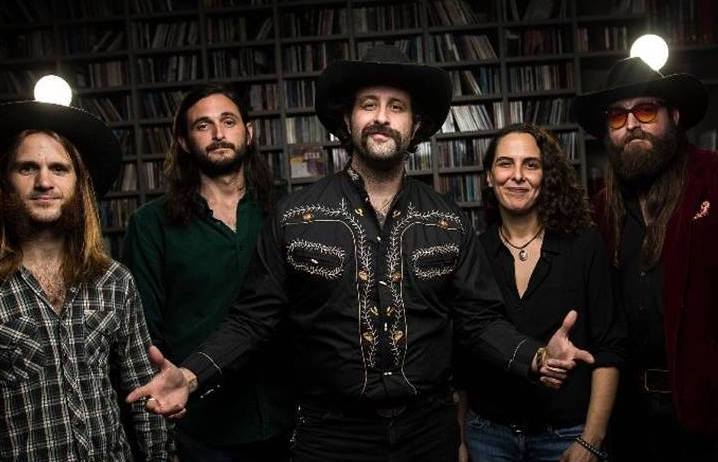
Croy And The Boys’ latest album would be powerful if it were simply a bleak examination of the way the deck is stacked against working people, history is whitewashed, and gentrification is proceeding along. But “What Good’s The Medicine?” finds even more strength in its hope for humanity. It would be easy to examine the systems we’ve created and assume the worst about the people involved. Instead, Croy ends the album by questioning the concept of original sin. His almost naive faith in human kind is remarkable and heartwarming.
Folk music is, at its purest, a genre that empowers and empathizes with the working man and woman. Croy is armed with evidence and anecdotes. The title of the album is a reference to soaring prescription costs and our never-ending dependence on them. Croy, a construction worker during the day, doesn’t sound thrilled with his life on early tracks like “What I Had to Do” and “The Tunnel Has No End.” His failed try at college left him with debt and he works hard to support his family, though the obligations to others and society weigh on him. The reality is a bit more complicated.
“I do think about things a lot and I try to process the world around me and sometimes it comes out negative,” Croy said. “I don’t think it’s all doom and gloom but I think people have to work really hard to make it if you’re working class.”
Though college didn’t work out, Croy doesn’t regret some of the critical thinking skills he learned there. And though having a kid forced him to give up on making music a full-time career, he is getting to spend the time with them he decided to pursue instead.
“I think that there are pathways, I think the unions can help deliver you some measure of stability,” Croy said before noting that the possibility of injury still makes life in the trades fragile.
One form of social criticism Croy wholeheartedly endorses is on display in “Video Spectrum In Bowling Green.” He details some of the incredible cultural discoveries he made in a small business and how his options dwindles as it was replaced by a Blockbuster and then a Redbox. Sure it ignores the advent of streaming, but this isn’t quite about a video store. It’s about gentrification in Austin
“I’ve been here for 15 years and there’s been lots of change and most people would interpret it as way too much growth,” Croy explained. “The loss of [the video store] was more that just a movie store closing. It was one of these touchstones of classic old Austin goes away. I think Austin was a place that for a long time was full of creative people where you could come as an artist and be inspired. With the rising cost of living here, a lot of this has gone away.”
Croy’s personal politics are very much left of center on the album, though he absolutely doesn’t identify as a Democrat.
“I feel like I live a little outside of the American political spectrum, Croy said. “The Democrats aren’t providing anything other than things not getting worse. Joe Biden said as he was running that nothing will fundamentally change and we’ve seen that to be true.”
Croy was particularly upset at the steps Biden took to avert a railroad strike by declaring it would be illegal for the union to do so.
“He stood on the side of capital against labor and working people see that.”
But it’s the hope that makes all the sadness documented on the album tolerable. “Better Man” and “I Get By” show flashes of it. The idea of self improvement and coping in the face of injustice isn’t exactly liberating, but it’s necessary and well spoken. “Throw ‘Em Out,” by contrast, is a brief trip into a progressive society we can only dream about. Or, perhaps, one day achieve.
“I think it’s really helpful to spend time thinking about what a better world would look like instead of just looking at problems,” Croy explained of the song, maintaining that humans are capable of building something better. “I think that human beings are a communal species. We’re not the fastest, we’re not the strongest, we don’t have big claws or sharp teeth but we’ve been able to survive through community.”
Even if Croy returns us to reality in the form of “I Know About No Money” before concluding his album, his earnest case for a utopia resonates.
“Through history, the things that we do together have defined our humanity, Croy said. “I think we live in a system now that pits us against each other in a lot of ways, but I think that’s unnatural.”
Above is the full episode as aired on WUSB’s Country Pocket, including both my interview with Croy and the songs we discussed, starting with “What I Had To Do,” which starts the album with a little bit of autobiography. The interview begins with the second video in the playlist. You can hear the show live every Monday at 11am on WUSB 90.1 FM or check the blog to watch it as a YouTube playlist. Visit http://www.WUSB.fm and http://croyandtheboys.com for more.

 Country Pocket