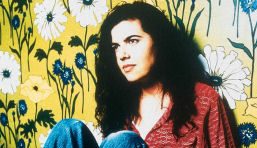
For the last several years and few albums, Maia Sharp has been starting over. She left a decades-long marriage and her home state. It hasn’t always been an easy process, but Tomboy is an excellent window into someone embracing change and opening herself up to life. The title track, which explain one thing that’s remained consistent about her since childhood, is the only song to suggest things can be constant.
“I was pretty resistant to change, or afraid of it. Now it’s a theme,” said Sharp. “I want to always be changing. I want to always be looking for the next thing. I welcome things that are a little scary. After doing this for 30 years, I don’t want to be too comfortable.”
Sharp had initially resisted taking the big swings needed to make her changes. Part of that was being unsure how or when to start. Sharp also was hesitant to get divorced or move across the country until she could make sure she didn’t lose her connection to her now ex-wife.
“We worked hard. We spent a year redefining who we were going to be moving forward knowing that we were no longer going to be married,” said Sharp. “That was what made it possible for me to make the changes. It was very important for me to keep her in my life. It was very important for me to keep her close.”
The process has paid off after a few difficult years.
“Even when I left, I still wasn’t sure, but I knew I wasn’t going to see it from the inside. I had to get into another situation to realize what had to grow,” said Sharp. “Three albums ago I’m still in the storm. My last album I’m on the edge of it. This one I feel like I’m pretty much out of it and have a clearer view looking back and hopefully looking forward as well.”
Sharp’s openness to looking forward can sometimes come with difficulties. On “A Fool In Love Again,” she seems to realize that a new relationship might not come with the same magic associated with falling in love in her 20s. She describes the recklessness and thrills as “drowning out the truth in my desire.” Now in her early 50s, Sharp is looking again and finding it difficult to embrace anyone wholeheartedly.
“I want to fall in love from this new vantage point in life,” said Sharp. “Is it the same? I don’t know what it’s going to feel like. I don’t know if [I will] either. I see red flags from a mile away. It can’t possibly feel like it did when I was 25. Hopefully it will be its own thing.”
One of the funnier songs on the album is “Counterintuition,” where Sharp essentially admits she needs to start doing and thinking the opposite of whatever she’s been doing to have success in the dating world. A lot has changed, most significantly the introduction of dating apps, and Sharp is recognizing the sorts of things that works in a marriage don’t do nearly as well there.
“I think I came out of the gate being too open. This is how vulnerable and real I am. I think it scared everybody away,” said Sharp. “It felt like for the first three months or so, everything I said was just the wrong thing. Everything was attracting exactly what I didn’t want. At first it was really frustrating and then it was just hilarious.”
As an artist, Sharp has benefited from her openness and ability to express herself. She also talks about benefiting from not wanting to be famous or chase any huge amount of financial success.
“Here’s the real me. Hopefully you like it, but if you don’t, it doesn’t change anything,” said Sharp. “The more that I settle into that idea and the less that I’m concerned about how other people respond, the better they seem to respond.”
As the changes have come, Sharp has been careful to make sure she’s being authentic to herself, especially as someone living in the public eye.
“I knew to be careful to check myself at every point along the way that this feels right,” Sharp said. “If you start to go down a path that isn’t entirely you, if you start to represent yourself as even something that you are slightly not, you have to keep on backing that up and doubling down.”
“Nobody survives a good conversation/nobody survives a good song/whoever you were before the transformation is gone,” begins “Any Other Way.” The lines are Sharp’s strongest on Tomboy and give the listener an idea of just how complete her process of change has been. She points to her work with Songwriting With Soldiers as the inspiration for the thought.
“I walk out of those rooms every single time – and it’s been over 100 times now – and I know that I’ve been changed,” said Sharp, who believes change comes fairly easily with if one is “just not resistant to it.”
Songwriting, in addition to a source of income and an outlet, is a way of measuring change and making it permanent for Sharp.
“Very often for me a song is a reminder of something I learned. I don’t want to forget it,” said Sharp. “Having that song out there, every time I hear it, it will help me to make sure I don’t lose any ground.”
Sharp mentioned that the most satisfying part of her career, especially post Covid, has been interacting with fans who perhaps felt they hadn’t survived her songs unchanged.
“In the past few years I’ve come to really enjoy the live shows and the hang afterwards. I get to real time, first hand, see the reaction and hear what the songs meant,” said Sharp. “Sometimes there’s a meaning in the song that I didn’t intend. But they heard it because that’s what they needed. It’s overwhelming. It fills me up.”
Above is the full episode as aired on WUSB’s Country Pocket, including both my interview with Maia Sharp and the songs we discussed, starting with Asking for a Friend, which, as you might expect, is not about a friend. The interview begins with the second video in the playlist. You can hear the show live every Monday at 4pm on WUSB 90.1 FM or check the blog to watch it as a YouTube playlist. Visit http://www.WUSB.fm and https://www.maiasharp.com for more.

 Country Pocket