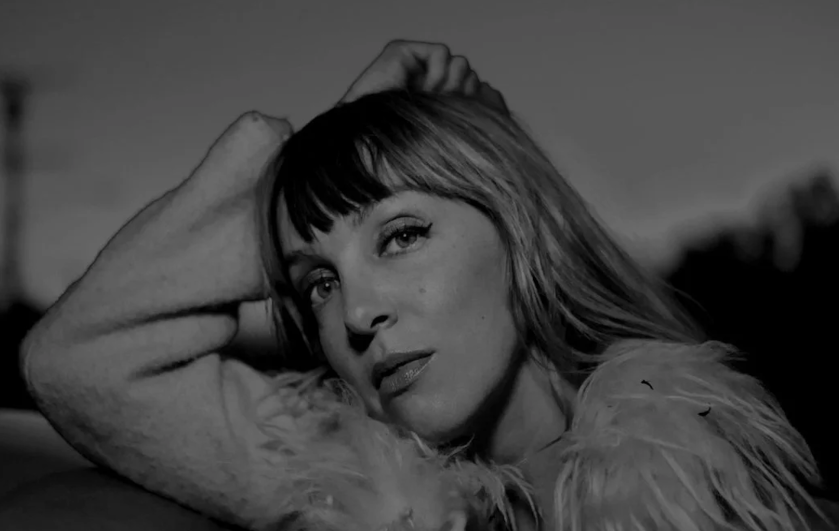
“My attitude towards healing is that it’s never done. There’s no such thing as healed,” said Laura Burhenn, lead singer and songwriter for the Mynabirds in one of the most emotional Country Pocket interviews I’ve recorded over more than a decade on air.
There’s a very crucial distinction between Burhenn saying that healing can’t be finished and that healing isn’t possible. It’s Okay To Go Back If You Keep Moving Forward is a testament to her belief in the possibility of healing, even at the cost of wading back through the darkness and pain. It’s actually so important and so constantly ongoing that she has no choice but to. Given what Burhenn has to say on this masterpiece of grief and evolution, it seems insane to ever ‘go back’ to the sources of her pain. And yet, it’s in the exploration of those terrible feelings that she’s able to land somewhere much closer to happy by the end of this saga.
Moving forward with deep trauma is like trying to move against a ferocious gravity pulling you back toward the worst moments of your life. In a move straight out of a NASA mission, Burhenn uses this gravity as a slingshot. It’s a high risk manoeuvre that only propels her to where she’s trying to go by circling the rim of a black hole. It’s bleak, but successful. This is not an album for the faint of heart, but it’s absolutely for anyone who’s been shattered.
“I’m as fragile as fragile can be/I’ve been torn at the seams,” Burhenn sings on Velveteen. She describes her state well on the first two tracks, though the specificity of feeling doesn’t do much in the way of revealing what happened to her. “Ramona, Patron Saint of Silence,” will immediately answer that question for anyone who’s ever been a victim of a predator. “Did you worry about the worlds you’d incinerate with the things that you’d say?” Burhenn sings on that track. Now we’re getting somewhere.
“In survival mode, we have the four Fs: flight, fight, freeze, or fawn. Silence is a sort of freezing that we do and it keeps us safe,” said Burhenn. “In that space, I think I realised I stopped writing because I had encountered a big trauma in my life and I needed to stay frozen for a while to be able to survive. Ultimately, the song is a thank you letter to whatever force protects us while we heal. Also, it’s a letter of gratitude to the power of our voice and the worlds we could destroy when we are ready to speak out.”
Speak out Burhenn does. She doesn’t name the source of her pain, but she paints him as successful in the music industry with a perverse appetite. “Tell me how does she taste?/I know how you like your meat/Fresh as a daisy,” she sings on “Drinking Song,” one of the darkest, most stomach turning tracks I’ve ever empathised with. Burhenn was already taking risks describing assault in such raw terms. But the anger, jealousy, and initial lack of empathy she displays toward what is clearly a fellow victim pushes this track into heart-stopping territory. “Can you do her a solid?/One thing I wish you’d done for me/Please make it bleed,” Burhenn sings, letting all those emotions out at the same time as wishing her own scars would be more visible and easily understood. There’s a reason Burhenn sat on this song for as long as she did. These are hard words to think and impossible to unspeak.
“I wrote it during the Me Too era. I like many people became very aware of abuse and trauma that I had suffered and witnessed. There was a real reconning,” said Burhenn. “I wrote that song and I didn’t know what to do with it. I was so disgusted by that song, I was so disgusted by the feelings that were coming up inside of me. It was something I was witnessing across the music industry. A younger and younger person keeps getting ushered in and I know what that exchange looks like. I know personally that it wasn’t great. Often times, it wasn’t consensual. I sang that song out of so much anger that I didn’t know what to do with it.”
That’s the ‘going back’ part of the album title. Dancing on the edge of that black hole, teardrops being sucked in, barely believing there’s a way out. That’s the years of silence being broken with the most blood curdling scream.
“There’s just this energy in this world of people taking and extracting whatever they want,” said Burhenn “I can’t abide this anymore.”
It’s okay if you barely made it this far. Burhenn created powerful medicine with this release, but not all medicine cures all wounds. The good news is that the rest is moving forward. Crucially, “Drinking Song” puts that on display before it ends. The last refrain tries desperately to take those words back.
“Maybe if this happens to someone else, I’ll feel less alone and we can commiserate over it,” Burhenn started, describing it as a horrible thought.
“I don’t want anyone to experience this hell,” she finished.
“Allowing both that original thought and that more evolved, more healed thought to exist together in that song was important. It’s not neat, it’s not tidy what people experience when they’re dealing with abuse, when they’re healing,” said Burhenn. “I think part of the healing process is allowing the darkest thoughts to bubble up and get free. I think if I can say it out loud, hopefully anyone who hears it will feel less alone.”
Once the darkest thoughts came free, lighter ones followed. Burhenn is a Buddhist and early on in our conversation mentioned the core belief of “be the change you want to see.”
“I think that we are all operating from some place of trauma, and the more we can look that in the eye and work to heal that within ourselves, I think we heal the whole world,” said Burhenn. She described wanting to write this album from a collective voice. She cited Maya Angelou, another victim of abuse who chose to remain silent for years before putting extraordinary words to the page.
“I think there’s this lineage of voice throughout human history and I feel like that’s part of what I’m singing about,” said Burhenn. “What does it sound like when people who have been oppressed and repressed finally recognise their own worth and speak up for themselves?”
Two strains have emerged in Burhenn’s thinking. The first is best described in “Ramona, Patron Saint of Silence,” when she embodies a volcano: “there’s wisdom in the fire/and some things need to burn.”
“I struggle with what it means to be a force of peace and love in the world and the truth of the matter is that some things need to be destroyed,” said Burhenn. “Destroying the old world to make way for the new one is also an act of love.”
Burhenn sees this happening even today, in the partial release of the Epstein files and the slow movement toward justice for at least some of the abusers. She also sees a lot more systems that need to burn. Yet Burhenn doesn’t want to see people destroyed, even the bad ones. Being the change she wants to see means loving. Loving means showing kindness to people who may not deserve it at the time – or possibly ever.
“I also wish for all the abusers to heal,” said Burhenn. “The best thing you can do when faced with an abuser is stop their abuse. Not only are they hurting other people, they’re hurting themselves too. If you come from a place from deep love and forgiveness, that’s what you want.”
That extends to participants some systems creating a lot of trauma at the very moment. Burhenn describes her philosophy as being focused on comforting those who are hurting, as opposed to just finding a way to get through pain.
“When your outrage is rooted in love, you cannot fail,” said Burhenn. “Be they an ICE agent or a racist asshole, I fully believe that their position comes from fear and ignorance. When I come face to face with that energy, I have to be courageous and full of love.”
“We won’t surrender a thing/by disarming,” Burhenn sings on “Disarm,” a track toward the end of the album.
“It’s not that we don’t choose to fight, it’s that we choose to do it differently,” said Burhenn. “I’m here for peace, I’m not going to roll over. I’m going to take the gun out of the person’s hand so they can’t hurt anybody else.”
It’s Okay To Go Back If You Keep Moving Forward ends on a very hopeful note. “LA Rain” describes a loving embrace, a person who has become a safe place to hide. Burhenn seems to genuinely have found peace in her personal life and is convinced we might yet find it on a larger scale as well.
“Hope has clawed through some heavy shit to get to the other side,” said Burhenn, quoting something she saw online. “I think that same thing about love. Love protects the people we care about and the vulnerable.”
Systemic abuse truly animates Burhenn. She’s active on social media, posting her thoughts about healing and her opposition to what the current administration, led by an individual who has been found liable in a court of law for the type of abuse described in “Drinking Song.” Having already faced it up close, Burhenn doesn’t seem daunted by the moment.
“We’re in the thick of it,” she admitted. “But we are going to get those assholes out of power. This moment is terrible and temporary.”
Above is the full episode as aired on WUSB’s Country Pocket, including both my interview with Laura Burhenn of The Mynabirds and the songs we discussed, starting with Ramona, Patron Saint of Silence, which covers Burhenn’s absence from the songwriting world. The interview, easily the most tearful I’ve ever conducted, begins with the second video in the playlist. You can hear the show live alternate Wednesdays at 8am on WUSB 90.1 FM or check the blog to watch it as a YouTube playlist. Visit http://www.WUSB.fm and https://www.themynabirds.org for more.

 Country Pocket