Posted in Uncategorized

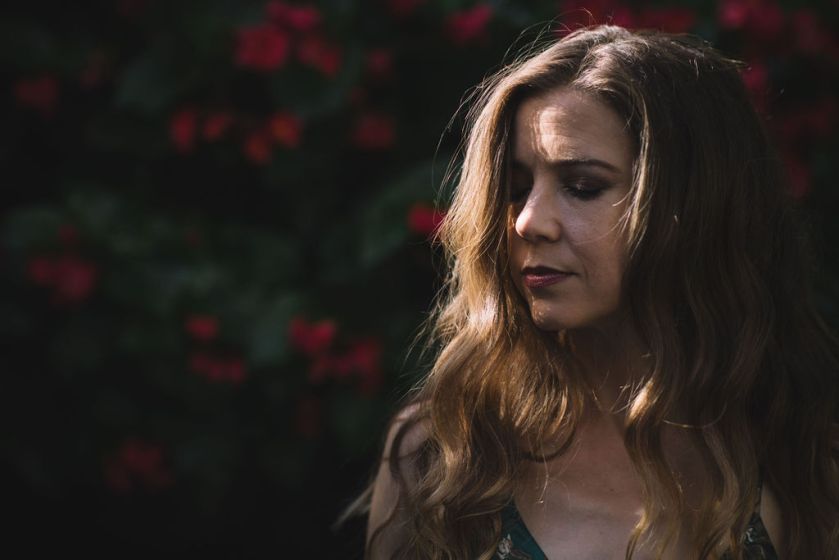
Hannah Delynn’s Trust Fall is a Bittersweet Moment of Growth and Realization

Trust Fall is a mature record from an up and coming artist. Hannah Delynn’s first track, “For The Record,” is a goodbye song that’s part apology, part affirmation of the decision to leave. There’s very little bitterness about a situation that had to have been fairly difficult. “I want the best for you,” Delynn sings of someone who hurt her enough to cause the singer to end something that could at times be beautiful. 

There are folk albums that paint scenes with such detail you can practically see what you’re hearing. Trust Fall perhaps the exact opposite of that. There are breakups, fallings out, and other strains but we never get a clear picture of what’s going on past the notion that one song might be more about a family member and another focused on romance. Somehow, that’s a good thing. There’s a universality to songs heavy on feelings and concepts and light on specifics. There’s also a little dignity and privacy for the artist and subjects. An artist may choose to put her life on display, but those around her probably haven’t. When she says she wants the best for someone, it’s easy to believe her. She’s providing them with the room to achieve whatever that looks like. Delynn’s message of understanding is “a learned practice,” but it certainly feels genuine.

“I have realized over time that most people are trying to do their best with the tools they have,” said Delynn. “I think something that’s been really helpful for me is to try to assume goodwill and good intent and recognize everyone’s humanity. It has not been an easy journey by any means, but I think it grants myself a lot more peace.”

The best part about an album like this is the measured quality of Delynn’s assessment. She’s not lashing out or beating herself up. She’s on her own list of people she wants the best for. 

During our conversation, I decided to stick with the spirit of Trust Fall and respect the privacy of Delynn and those involved. I was happy to ask her to explain what she meant, but reluctant to push for details on what happened. If she had wanted to air those parts of her life, I suspect she would have addressed them under the optimal conditions of being able to write and edit the stories. 

“Talking about things that have hurt me was a very new experience and I felt really scared about doing it,” said Delynn, who added that some of the subjects of her songs have heard what she wrote. “I’m trying to infuse talking about difficult things with some grace. A lot of this record is beginning to realize my own part. Being human is hard sometimes, and I’d rather go into this record stating that I acknowledge that.”

Delynn has had to get comfortable with a lack of closure. Many of the situations she sings about on Trust Fall are unresolved in some way. Just as there are details missing in the stories we’re hearing, there are pieces missing for their author.

“So much of my experience of healing has been being able to sit with that discomfort and uncertainty,” said Delynn. “You might not get the conversation that you still hope to have with a friend, a family member, an ex. I think the way we can help ourselves is to get comfortable in discomfort, or at least find tools and ways of coping that create more peace within ourselves and therefore ripples out into our lives.”

Many of Delynn’s difficult conversations on the album are with herself. She’s questioning her past actions. She’s unsure how she let others get her into bad places.

“It’s painful to reckon with time lost. There’s so much up to that point where [I wonder] why didn’t I see this sooner,” asked Delynn. “We can cultivate gratitude. You wouldn’t have gotten to the good place if you hadn’t had messed up. You’re only becoming the best version of yourself because of that hardship.”

It’s a muscle she describes as having to develop slowly as she learned how to speak to herself in a different way.

“How would I talk to someone else I love if I don’t want to talk to myself this way,” Delynn asked. 

“Leaf on a River,” the album’s most gorgeous song, is about recognizing that she needs to relax and let things be. She came to understand that she can’t control others and can’t change the past. 

“If I can forgive her/I might reach the sea,” she realizes. 

“I feel like you can catch glimpses of it,” she said of her sea. “I think I’m getting better at creating my own internal peaceful sea. But it certainly can be stormy weather in there sometimes.”

The name Trust Fall comes from Delynn making vital changes to heal, even if it meant stepping onto unsteady and new ground. Her sense of having lost time and not lived to her fullest it at its strongest on the serene but agonized last track “Waiting.” 

“I don’t feel quite finished yet/When this sun sets/maybe I’ll get another,” Delynn sings on waiting.

“I had been experimenting in my life by instead of waiting for the conditions to be right, acting and hoping a net will appear,” Delynn said. “Almost testing the universe in a way by leading with the kind of life I want to have and seeing what responds.”

Delynn has learned to readjust her expectations in all kinds of relationships and to change what she values.

“When someone shows you what they’re willing to give you, I think it’s learning to read that and accept that and begin to set your expectations accordingly,” Delynn said. “Reciprocity has become a huge gauge.”

Trust Fall is a gorgeous and calming record that covers all kinds of awareness of self and awareness of others. It’s mature in both wanting the right things for others and learning to accept what might be best for yourself. While I tend to prefer albums rich in detail, this one in particular works with fairly little: it’s probably best to fill in the gaps with details from your own life.

Above is the full episode as aired on WUSB’s Country Pocket, including both my interview with Hannah Delynn and the songs we discussed, starting with For The Record, which extends grace in a difficult situation. The interview begins with the second video in the playlist. You can hear the show live every Monday at 4pm on WUSB 90.1 FM or check the blog to watch it as a YouTube playlist. Visit http://www.WUSB.fm and https://hannahdelynn.com for more.

Posted in Uncategorized

Maia Sharp Embraces Change and Connection on Tomboy

For the last several years and few albums, Maia Sharp has been starting over. She left a decades-long marriage and her home state. It hasn’t always been an easy process, but Tomboy is an excellent window into someone embracing change and opening herself up to life. The title track, which explain one thing that’s remained consistent about her since childhood, is the only song to suggest things can be constant.

“I was pretty resistant to change, or afraid of it. Now it’s a theme,” said Sharp. “I want to always be changing. I want to always be looking for the next thing. I welcome things that are a little scary. After doing this for 30 years, I don’t want to be too comfortable.”

Sharp had initially resisted taking the big swings needed to make her changes. Part of that was being unsure how or when to start. Sharp also was hesitant to get divorced or move across the country until she could make sure she didn’t lose her connection to her now ex-wife. 

“We worked hard. We spent a year redefining who we were going to be moving forward knowing that we were no longer going to be married,” said Sharp. “That was what made it possible for me to make the changes. It was very important for me to keep her in my life. It was very important for me to keep her close.”

The process has paid off after a few difficult years. 

“Even when I left, I still wasn’t sure, but I knew I wasn’t going to see it from the inside. I had to get into another situation to realize what had to grow,” said Sharp. “Three albums ago I’m still in the storm. My last album I’m on the edge of it. This one I feel like I’m pretty much out of it and have a clearer view looking back and hopefully looking forward as well.”

Sharp’s openness to looking forward can sometimes come with difficulties. On “A Fool In Love Again,” she seems to realize that a new relationship might not come with the same magic associated with falling in love in her 20s. She describes the recklessness and thrills as “drowning out the truth in my desire.” Now in her early 50s, Sharp is looking again and finding it difficult to embrace anyone wholeheartedly. 

“I want to fall in love from this new vantage point in life,” said Sharp. “Is it the same? I don’t know what it’s going to feel like. I don’t know if [I will] either. I see red flags from a mile away. It can’t possibly feel like it did when I was 25. Hopefully it will be its own thing.”

One of the funnier songs on the album is “Counterintuition,” where Sharp essentially admits she needs to start doing and thinking the opposite of whatever she’s been doing to have success in the dating world. A lot has changed, most significantly the introduction of dating apps, and Sharp is recognizing the sorts of things that works in a marriage don’t do nearly as well there. 

“I think I came out of the gate being too open. This is how vulnerable and real I am. I think it scared everybody away,” said Sharp. “It felt like for the first three months or so, everything I said was just the wrong thing. Everything was attracting exactly what I didn’t want. At first it was really frustrating and then it was just hilarious.”

As an artist, Sharp has benefited from her openness and ability to express herself. She also talks about benefiting from not wanting to be famous or chase any huge amount of financial success.

“Here’s the real me. Hopefully you like it, but if you don’t, it doesn’t change anything,” said Sharp. “The more that I settle into that idea and the less that I’m concerned about how other people respond, the better they seem to respond.”

As the changes have come, Sharp has been careful to make sure she’s being authentic to herself, especially as someone living in the public eye. 

“I knew to be careful to check myself at every point along the way that this feels right,” Sharp said. “If you start to go down a path that isn’t entirely you, if you start to represent yourself as even something that you are slightly not, you have to keep on backing that up and doubling down.” 

“Nobody survives a good conversation/nobody survives a good song/whoever you were before the transformation is gone,” begins “Any Other Way.” The lines are Sharp’s strongest on Tomboy and give the listener an idea of just how complete her process of change has been. She points to her work with Songwriting With Soldiers as the inspiration for the thought.

“I walk out of those rooms every single time – and it’s been over 100 times now – and I know that I’ve been changed,” said Sharp, who believes change comes fairly easily with if one is “just not resistant to it.”

Songwriting, in addition to a source of income and an outlet, is a way of measuring change and making it permanent for Sharp.

“Very often for me a song is a reminder of something I learned. I don’t want to forget it,” said Sharp. “Having that song out there, every time I hear it, it will help me to make sure I don’t lose any ground.” 

Sharp mentioned that the most satisfying part of her career, especially post Covid, has been interacting with fans who perhaps felt they hadn’t survived her songs unchanged.

“In the past few years I’ve come to really enjoy the live shows and the hang afterwards. I get to real time, first hand, see the reaction and hear what the songs meant,” said Sharp. “Sometimes there’s a meaning in the song that I didn’t intend. But they heard it because that’s what they needed. It’s overwhelming. It fills me up.”

Above is the full episode as aired on WUSB’s Country Pocket, including both my interview with Maia Sharp and the songs we discussed, starting with Asking for a Friend, which, as you might expect, is not about a friend. The interview begins with the second video in the playlist. You can hear the show live every Monday at 4pm on WUSB 90.1 FM or check the blog to watch it as a YouTube playlist. Visit http://www.WUSB.fm and https://www.maiasharp.com for more.

Posted in Uncategorized

Ann Liu Cannon Writes Her Own Myth on Clever Rabbits

On Clever Rabbits, Ann Liu Cannon went down some truly mythological rabbit holes. Her album documents thousands of years of folk tales and religion, 25 years of living, and an era gone by. Cannon’s intense love songs, a few years after the fact, don’t always make sense to her present day self.

“I think at that point in time I experienced love in a very innocent, naive, wholesome way, but it meant that I was very prone to losing all sense of my orders and dissipating internally,” said Cannon. “I felt very messy and very lost in where I ended and where other people began.”

If Cannon wasn’t able to experience healthy love, she was at least able to experience biblical emotions over it. “Jealous God” is a hurricane of emotion and sound formed around the suspicion of a partner cheating. Cannon justifies her jealousy by matching it with that of God, who is many times over stated to be jealous in the Bible. “He made us in his own eyes,” she sings. 

“When you’re in that jealous space, you play God in a way. It’s not an ideal thing to do to other people and yourself,” said Cannon. “I grew up around a lot of Sacred spaces. My schooling was through the Church of England and my father taught Sacred architecture. It didn’t mean that I was partaking – I’m not religious in a straightforward manner – but those environments mean a lot to me.”

The stories mean a lot to Cannon too. She said that she often compares events in her life to myths and proverbs. Speaking with Cannon, it’s clear that she sees just about everything on multiple levels. One line about smelling the fear of London was meant as both a reference to how the nose clears during moments of intense anxiety and how rabbits are always twitching their nose. When she identifies with characters in myth, she examines the implications that might have for her true desires. It’s a web of thought that’s nearly impossible to follow from an outsider’s perspective and yet genuinely fun to hear Cannon explain. 

“These are some of the oldest texts we have and I like to root everything I’m doing in the past,” Cannon said. “I naturally want to draw on these myths and legends to help me tell my story.”

While Cannon’s father came from England, her mother came from China. That means another few thousand years worth of myth have followed Cannon to the UK and reside within her. The album title is based on the proverb that “clever rabbits need three burrows,” or it’s smart to have backup plans. In one of the more surreal moments in the interview, Cannon described historic stone carvings depicting three rabbits that appear both in China and England. They hold a special place for Cannon, who identifies with both cultures and the fact that she was born in the Year of the Rabbit. 

“I got around in life a bit like a rabbit,” Cannon said at one point. “It’s very keen on burrowing away, very keen on the home, very sensitive to danger almost to the point where it gets very startled and at the very last minute they bolt. I think other people find the bolting quite jarring.”

Cannon described her own album as self-absorbed. She’s someone who often examines her own work critically, right down to her words during our conversation.

“To exist is to be angry,” she said at one point. “Did I say that? Oh my God I’m so dramatic” immediately followed.

To some extent, Cannon has a point. Others who feature on the album, most prominently her ex, don’t get a chance to share their perspective, she noted. While that’s not usually how albums work, the fact that Cannon is noticing limitations to her work shows she’s expanded her point of view since.

“There are things that are actually happening that you think are happening and there are things that are happening that you really have no idea,” Cannon said. “I was living in this myth land where all these things made sense to me. I feel safest in the written word.”

The surreal “Gobbleknoll,” a song about a myth about a hill that eats people, shows the way Cannon moves from myth to realization. In the story, a rabbit saves the day by ripping out the hill’s intestines. Her first reaction to the story was as a fan of interesting stories. (“This is fucking awesome,” she said.) Then she began identifying with the rabbit, as she tends to do. Before long, it was time to make a change.

“Perhaps if I want to kill my home then perhaps I’m not meant to be here and I’m not really a rabbit at all,” Cannon said. “Maybe you’re beyond the story you’re telling yourself. I can move beyond this story.” 

On “Mên-an-Tol,” which references a historical site in the UK, Cannon wishes to “love like humans do.” It seems telling that she’s asking this of a rock formation instead of an elder or peer. Being lost in Cannon’s head is a truly interesting experience, even if only for an album.

There’s one song on the album about someone she loves that is beautiful and thoughtful beyond anything she wrote about a partner. “I held him like he held me once,” she sings of her dying father on “False Hope.”

“I was visualizing forward what that death was going to be. I wanted to write a song that was very joyful,” Cannon said. “The process of watching someone die gave me so much joy. He was there at my first moments in the world and I was there in his last breaths.”

Cannon described it as more of an honor than a typical feeling of happiness and pointed out that a lot of meaning in our lives comes from the fact that they are temporary.

“When you’re confronted with death in that way, every other emotion gets so much more precious,” said Cannon. “The terror and the pain in that situation meant that when I did feel joy, that joy was so much more appreciated.”

It’s here that Cannon’s grasp of large time scales and the patterns of human stories benefits her most. If myth helps Cannon to process loss and to outgrow an old self image, it may just be a more healthy lens through which to view the world than she realizes. It’s strange, but it works.

Above is the full episode as aired on WUSB’s Country Pocket, including both my interview with Ann Liu Cannon and the songs we discussed, starting with Jealous God, which kicks things off with a fire and brimstone intensity. The interview begins with the second video in the playlist. You can hear the show live every Monday at 4pm on WUSB 90.1 FM or check the blog to watch it as a YouTube playlist. Visit http://www.WUSB.fm and https://www.annliucannon.co.uk for more.

Posted in Uncategorized

Trapper Schoepp Fights His Addiction And The System That Started It On Osborne

Trapper Schoepp’s first encounter with the worst disease he’d ever face came at a doctor’s office. Schoepp was dealing with chronic pain as a result of some BMX injuries and surgeries that had left him feeling a bit like “Frankenstein” and his doctor had decided the best course of treatment was a steady supply of pain pills. “You ain’t gave me nothing but a loaded gun,” Schoepp sings of the encounter.

Osborne is an album that traces addiction from first contact to recovery. It documents highs, lows, freedom, hopelessness, and searing anger. In our discussion, Schoepp admitted that it was difficult for him to talk about the issues that he faced. Addiction still isn’t an easy subject despite the overwhelming number of people who have faced it.

“There’s a mental health epidemic in America and an addiction epidemic in America. We’ve come a long way in terms of mental health and normalizing it, but I think addiction’s another thing,” said Schoepp. “There’s a lot of shame and isolation and guilt attached to it. What people need is acceptance and community and love. They don’t need more shame. A lot of people feel great shame for their addiction and it creates this vicious cycle.”

Schoepp sings on the album that he likes to do what he feels. BMX biking seemed like a good outlet for that. 

“It felt artistic at times. It was a cool way to express yourself as a kid,” said Schoepp. These days he expresses himself through music after injuries derailed him in more ways than one. “[It was] some pretty gnarly stuff for a kid to go through. The spinal decompression surgery was a tough one.”

Schoepp was given opioids by a doctor who seemed like he couldn’t prescribe enough pain pills to the young man, who was suffering from conditions like sciatica. While the album suggests the doctor should be classified as a criminal, Schoepp took a more nuanced approach in our conversation. 

“I think a doctor is influenced by an environment much greater than themself,” said Schoepp. “At the time, the environment was to put bandaids over pain that was deemed chronic or incurable. In some instances they’re warranted, especially in clinical settings. They’re dangerous. There needs to be more guardrails. Those medications have a way of tricking and training your brain.”

The environment Schoepp described had to do with an aggressive marketing push by Purdue Pharmaceutical, run by the Sackler family. There’s a little less nuance here and on the album, where Schoepp sings “Satan is a Sackler.” 

“The Sackler family really popularized the idea that chronic pain had to be treated forever,” Schoepp said. “They were really responsible for the opioid epidemic in America. They created this empire of pain. They were evil geniuses for creating the illness of chronic pain. They knew what they had. They knew it was highly addictive and they promoted it anyway. They blamed poor people in rural communities for getting addicted to their substances and they didn’t take responsibility.”

The judicial system decided they should take responsibility and forced them to pay $7.4 billion for their malfeasance. 

“There’s no amount of money for the pain that they caused, but it’s something,” said Schoepp, who said he’d be uncomfortable holding a bottle of pills to this day. The opioids served as a gateway drug into other substances for Schoepp, much like they did for many other Americans who became addicted by following their prescriptions.

“Osborne” isn’t a bleak album. It gets its name from the unit of a standout rehab facility Schoepp attended in Minnesota. It also happens to be the same facility Ozzy Osbourne recovered in. 

“If Ozzy can do it, I can do it,” Schoepp remembered thinking.

The process of recovery involved letting go of some hard feelings and developing willpower.

“It came in a couple different waves. I white knuckled getting off pain killers and it was absolute hell,” said Schoepp. “I came back into some other substances that I thought were not as addictive but ended up being just as much as an issue for me. I kind of went mad and I ended up at the Hazleton Betty Ford Clinic in Minnesota where you address the whole person.”

The approach has paid off. Schoepp moved past the attitude on display on the tragic and gorgeous “Tomorrow’s For Quittin’” and stuck with it. It certainly wasn’t a linear process, he explained, but by the time we spoke, Schoepp was wearing a sunhat and sitting in a field of sunflowers, speaking soulfully about what he went through.

“I think you need to follow your nose and follow your heart. Do the best you can and don’t be too hard on yourself That’s a big thing in recovery,” said Schoepp. “You go in trying to fix everything and you get this analysis paralysis. There are just little things you can do to get through the day.”

Schoepp says he’s still growing and considers himself and his art a work in progress. He chose to end the album on a note of encouragement. “Suicide Summer” is seemingly addressed to other addicts with much the same message he felt Ozzy was sending him: if he can make it, “so can you.” 

“I think it’s easier to not deal with something and move on,” Schoepp said. “The brave thing is to go head on into the storm.”

Above is the full episode as aired on WUSB’s Country Pocket, including both my interview with Trapper Schoepp and the songs we discussed, starting with Loaded, which introduces us to his first encounter with prescription painkillers.. The interview begins with the second video in the playlist. You can hear the show live every Monday at 4pm on WUSB 90.1 FM or check the blog to watch it as a YouTube playlist. Visit http://www.WUSB.fm and https://trapperschoepp.com for more.

Posted in Uncategorized

Anna Ling Finds Spiritual Truth In Science and Nature on Light

Anna Ling is in tune with something much bigger than herself. It’s natural, scientific, and spiritual. Carefully considered and instinctual. Anyone who listens to Light will understand that Ling has a unique connection to the world around her. She describes the human condition as being part of a mycelium, after the wide-reaching interconnected underground fungi. 

What’s remarkable is that even other creatures sense her respect and love for all that’s alive. Sitting in a barn, Ling received a visit on her shoulder from a butterfly.

“The tips of its wings had gotten caught up with cobwebs,” said Ling. “I brought the butterfly onto my hand and spent awhile just taking the cobwebs away from the butterfly’s wings and I managed to take enough of them away that they opened back up again. I took the butterfly outside and it flew away.”

It’s a serene and joyful moment. For Ling, it led to a beautiful piece on love and the interconnectedness of every being. A chance event became an opportunity for her to reflect: “I’m not really good at asking for help. I think that’s part of our hyper-individualized culture. The experience was such a huge gratitude. I felt like this butterfly had trusted me with this huge task.” 

It was Ling’s line about mycelium that really drew me in. It’s an obscure bit of knowledge that is only acquired through actively seeking more information about nature. Evolution, the Big Bang, and plenty more ideas more at home in a textbook show up on this fairly artsy folk album. 

“I love the imagery in science,”said Ling. “I love science as a creative way of understanding the world. I’m less into the nuts and bolts and more into the way these ideas make me feel.”

On “The Moon,” Ling addresses a relative so distant that she was among the first to leave the ocean: “Daughter of sea/

Grandmother tell me/Did you long for the land/What old song drew you up from the deep?”

Again, Ling starts reaching across the mycelium for connections.

“There are cultures around the world where they know the stories of their ancestors for numerable generations,” said Ling. “I don’t really know my grandparent’s grandparents. That’s kind of where the cutoff is. There’s this incredible mystery that goes all the way back to oneness.” 

She describes our one earliest ancestors as prone to kindness: “Some cell that decided to integrate its fellow cell rather than kill it.”

While most would agree that sexuality is part of the natural world, Ling writes as though the natural world is part of sex. On “Limerence,” she writes I am blood I am grit/With my thighs around your hips/I am the waves crashing cliffs/I am tectonic shifts

“Is sexual connection not one of the most intriguing and strange and wonderful part of this human experience?,” asked Ling, who said she often writes in moments of overwhelm. “Most of my most intense experiences have been romantic sexual relationships.”

A standout moment on the album compares a dead seagull tangled in plastic to Jesus Christ. One died for our sins, the other died as a result of them. The fact that we’re aware that life will eventually end is what Ling believes sets us apart from other life forms. Part of wondering about humanity and the natural world is contemplating death. 

“The structures that we’re living within will end; I can’t see how they won’t,” said Ling. “But we don’t know what’s on the other side. I feel like we’ve got everything to play for. We don’t have to necessarily nosedive into the sea.”

Ling’s spiritual beliefs, while unconventional, share a foundation with that of many other religions.

“I firmly believe that the core of this being is love and peace and light, said Ling. “We do tend to cover it up very successfully, but I have a great faith.”

Don’t let the lyrics distract you from some absolutely gorgeous sounds. Ling’s vocals range from airy to throaty on “Inevitable,” which would’ve made a sonic impression anyway its African folk instrumentation. The remaining nine songs are mostly rooted in English folk, as one might expect from a Devon artist. There’s something slower and softer about this music, though. The light Ling named this album for is not a harsh sun on a hot day, but one that illuminates and soothes. It’s gently penetrating the canopy on a walk through the forest. It’s just strong enough to see by and lasting enough to keep searching. 

Above is the full episode as aired on WUSB’s Country Pocket, including both my interview with Anna Ling and the songs we discussed, starting with Butterly, which demonstrates that even nature understands Anna’s connection to nature. The interview begins with the second video in the playlist. You can hear the show live every Monday at 4pm on WUSB 90.1 FM or check the blog to watch it as a YouTube playlist. Visit http://www.WUSB.fm and https://www.annaling.co.uk for more.

Posted in Uncategorized

Ross Thorn Mixes Absurdity and Profundity on Fitting In

Fitting in is not easy to do for many people. At 6’8”, Ross Thorn quite literally has trouble fitting in. Airplanes and cars are not his friends. There’s no disappearing into the crowd for a man who towers above it. Yet Thorn plays the situation for comedy before making a quick pivot to a more meaningful thought.

“There’s lots of people who have an even harder time fitting in,” said Thorn before listing a few marginalized groups. “Society doesn’t make it easy.” 

That transition in our conversation exemplifies two of the reasons Fitting In is such a beautiful work. First, Thorn is confident in his use of humor and his ability to leverage it to make a point. Second, he’s deeply empathetic, even when discussing his own problems. The third selling point of the album is Thorn’s recognition that there’s no shortcut when it comes to emotional processing.

The title track is a radical example of the self love needed to heal. Thorn steps out of his body to sing to himself, ending the song by repeating the phrase “I love you so.” 

“It’s a newer thing for me to say to myself,” said Thorn. “It feels really good to get to a place where you can say that.”

Thorn’s songwriting is certainly at its sharpest when he’s involving humor. On the song “Midwestern Goodbye,” Thorn chooses to demonstrate rather than describe a drawn out farewell. There’s even a point where the song comes to a natural end and the music stops. And yet, it continues.

“Goodbyes take forever. We’re all aware of someone who takes 45 minutes standing in the doorway,” Thorn said of his native region. “I think it’s a beautiful cultural phenomenon. I think it’s longing to connection in an area that has brutal winters.”

What starts with a joke ends with a deeper observation. There’s gentle humor like “Midwestern Goodbye” and then there’s cringe-worthy dark humor on “Pick-a-dee-day.” Grandad always said to keep your head up, the song’s logic goes, so any problem is all a perspective of attitude. Thorn goes so far as to tell an orphan to smile. By that point, the lines have even ceased to rhyme. The world view his character has been living with is causing him to crumble. 

“It’s inspired, weirdly enough, by The Lion King. Simba’s dad gets trampled in a stampede and then he meets two whimsical characters,” Thorn recounted. He’s not a big fan of Hakuna Matata in the face of such extreme circumstances. 

“I think you should worry about that.” said Thorn. “I think that’s something to process.”

“Scripts written by generations before us like ‘man up.’ There’s dangerous things to do or pass along,” said Thorn. He recognizes the importance of a good mindset, especially in the dark stretch we’re living through, but has come to understand that grounding exercises only work if you’re using that ground as a foundation for further work. 

“It’s not going to just be breathing exercises, because holy crap, everything is terrible,” said Thorn. “But if we need to get in a good headspace and feel motivated and hopeful, sometimes we have to catch our breath in order to actually make change.”

The most impactful listen on the album is written by Thorn from the perspective of a woman (“An exercise in empathy,” he called it) but sung by The Spine Stealers. “Far Away” is about escaping a bad situation in a worse way. The character meets a man and sees him not for who he is but for the opportunity he represents: “For a fleeting moment/I could find my hope in him./He could take me far away real soon.” She soon finds herself across an ocean and once again dreaming of escape.

“It’s the same stuff because everything you carry with you is there until you face it,” said Thorn. “One of my biggest breakthroughs in therapy in recent years is to sit in discomfort and give it the space and acting with a clear head.” 

Thorn, a man who has dealt with some emotional issues and lives the sort of life that allows him to travel far and frequently, thinks the notion that we just need to find greener grass is flawed.

“It’s less escaping and more confronting,” said Thorn. “I don’t think it’s possible to just run away.” 

When it comes to the multitude of problems facing the world right now, it may literally be impossible to run away from it all. Not even the would-be trillionaire crowd has built a rocket to Mars yet, and even that would feel isolating. The solution Thorn offers is on the opposite end of the coolness spectrum. “In a world full of anger/I’ll bear a grin,” he sings.

“To be able to find a smile is really a gift,” Thorn said. “I’m able to find that joy and that’s really special.”

That joy doesn’t come from being told to feel joy. Sometimes it’s the result of dark humor at the expense of a Disney classic. Sometimes it’s the result of accidentally terrifying an old woman while dressed as a clown on the railroad tracks in an effort to shoot an album cover. Sometimes it’s even less sexy than that.

“I love you so,” Thorn repeats nine times at the end of his album. If he has to say it that many times for it to sink in, so be it. It seems more effective at helping Thorn smile than any folk wisdom about needing to do so.

Above is the full episode as aired on WUSB’s Country Pocket, including both my interview with Ross Thorn and the songs we discussed, starting with the title track, which may be the type of talk we all need to give ourselves. The interview begins with the second video in the playlist. You can hear the show live every Monday at 4pm on WUSB 90.1 FM or check the blog to watch it as a YouTube playlist. Visit http://www.WUSB.fm and https://rossthornmusic.com for more.

Posted in On Air, Top Picks

Rebecca Porter Refuses To ‘Roll With The Punches’ Any Longer

Testimony can be a uniquely powerful thing. Rebecca Porter airs her struggles on her powerful debut album Roll With The Punches, but she’s not looking for pity. Whether Porter is outlining what not to do or expressing raw determination, she’s crafting a survival guide. It’s a portrait of someone emerging from the darkness of abuse who believes she deserves more with the zeal of a convert. It’s also a bit of a reckoning with cosmic justice: few albums have started with a more powerful first line than “God blessed the men who did me wrong too many times.”

The change in Porter’s thinking is most clear if you use “The Devil” as a starting point. 

“I kept excusing things that were happening because I had seen worse or that this isn’t something new to me,” Porter said when we spoke. This darkness included abuse inflicted on her as a child and violence inflicted on her as an adult. Somehow, she never let the darkness consume her. 

“I’ve always had this innate belief of hope,” said Porter. “Even though times could get really terrible, I just felt like on the other side of it was something better.” 

It took a long time for Porter to get from a mental health crisis to making music. Therapy, which hadn’t been much help earlier in her life, finally made a real difference. 

“I felt that I had moved on from it enough that I could use writing and music to further find my voice and keep pushing out of those cycles and away from the triggers that could easily take over an entire day or week,” said Porter. 

Porter’s transformation came in part as a result of her son. 

“Having my child and the journey that I’ve been on with him and needing to advocate for his needs has further enabled me,” said Porter. “I’m actively working to counter those experiences and trauma from my life to ensure his life is different.”

One pattern she sought to break was that of her parents, who got caught in a cycle of payday loans and bad finances. “Life grips onto two stubs in your hands/Interest running through your fingers like sand,” she sings on the album. Another situation she sought to avoid was bad religion. Exclusion and even aggression towards people who are othered is the sort of thing that’s left Porter conflicted on the topic. It led to particularly painful lines about the notion that others do not want her to exist.

“It’s very unfortunate, I was raised independent fundamental baptist. I was the only person other than my sister who looked like me in that church,” said Porter, of Pacific Islander ancestry. “It wasn’t until I went to public school that I really noticed a shift in how I was treated.”

During our conversation, she spoke most passionately when she imagined speaking to someone using their faith to discriminate. 

“What happened to you to make you so hateful and so mean that that is what you see in other humans,” asked Porter, who is non-binary. “There’s a huge demographic of people who are afraid of others because people have been demonized to them. It’s very sad to me. “If God is in control, then why does God let children get cancer? There’s this bigger reason, but queer people existing is not part of that? I just see people as who they are and who they tell me they are. It’s not for me to decide. “I don’t know if I’m in line enough with my spirituality to say if God makes mistakes, but I don’t consider people and who they are mistakes.”

Porters voice is clearest on the title track. She describes how much abuse and pain she swallowed, warning that she “almost died.” 

“Just holding onto the trauma and the cycles of abuse and swallowing everything that’s been handed your way will inevitably consume who are. It’s probably impossible for your self talk to be anything but negative and hateful,” said Porter. She credits therapy with a major change in her thinking. “There are times when I still have negative talk, but I understand that’s not how I should speak to myself. That was a learned narrative. I still have times when I have to remind myself that I am worthy of good things. I don’t have to do anything extra to prove that I am worthy to exist.”

Therapy has even allowed her to react to the blessings men who abused her have received. 

“If I’m focusing on their blessings and all of the good things happening for them, I might be missing things that could be happening for me or things that I could be working on to get out of the situation,” said Porter. “I spent so much of my life wanting an apology or wanting an acknowledgement from those men in my life. I learned that with many of them, that was not going to happen.”

Moving forward, Porter is ready to hold people to standards similarly high to those to which she holds herself.

“Safety is something that is a concern for me, it’s a concern for people I play with,” said Porter. “I’m not willing to chance my own safety or people who play in my band or family’s safety because I ignored those signs.” 

Rolling with the punches has meant Porter knows from which direction they come.

“You’ve been here before. You’ve heard these words from someone before,” said Porter. “Where did this lead in the past? I don’t have to just accept what they’re willing to give me.”

Above is the full episode as aired on WUSB’s Country Pocket, including both my interview with Rebecca Porter and the songs we discussed, starting with Shadow of Doubt, which shows Rebecca emerging from a mindset in which she accepted poor treatment. The interview begins with the second video in the playlist. You can hear the show live every Monday at 4pm on WUSB 90.1 FM or check the blog to watch it as a YouTube playlist. Visit http://www.WUSB.fm and https://www.rebeccaportermusic.com for more.

Posted in Uncategorized, On Air

Marina Florance Captures Stormy Emotions In Serene Songs

In a world where everyone shouts and attempts to dominate through law and violence, Marina Florance gets her point across calmly. There’s tremendous purpose behind that style. Whether it’s a spoken word piece that sounds like it’s delivered by a gentle English granny – an accurate assessment – or a quiet folk song, Florance’s music lets her lyrics do the speaking loudly. Speaking up, or even more literally speaking, become repeated topics on the album. Florance sympathizes with the voicesless, whether they’re emotionally unable to express themselves or simply swallowed up by the harsh realities of our political culture.

On “A Few Days In May,” Florance tells the story of a woman in the hospital pointing to a “nil by mouth” sign to justify not speaking. Anyone who goes through such a serious illness certainly has a right to feel overwhelmed. 

“The withdrawal of their voice is still power,” Florance said. “It still gives them something they’ve got control over.” 

Florance finds a lot wrong with communication these days. On the one hand, everyone has the power to post on social media or, say, to a folk music blog. On the other, it seems like those in power are only interested in hearing the most extreme voices. She views conflicts as situations that can be improved in a way that preserves the dignity of all weather than pick a side. There’s nuance in issues like that, but absolute conviction in how human beings should be valued. The climate as it currently exists is not great for voices like hers.

“It doesn’t matter how hard you shout or what the reasoning is, it makes no difference,” said Florance. “I think a lot of us shut down to the extent where we say nothing.” 

She’s worried that people are actively rejecting the notions of compromise and democracy.

“I’m always trying to placate, but no one wants it anymore; they just want conflict,” said Florance. “And I’m not sure that talking in a world that just wants conflict really helps. So I write stuff down. I’m quite old. We’ve seen this thing so many times. And to be coming around this block again, it’s exasperating, it really is.”

The best sung track on the album, “Shadows,” is an intimate description of mental illness that could truly only be authored by someone with a good understanding of it.

“You just wake up one morning and there it is. It doesn’t matter if it’s sunny outside. This shadow comes over you and you have to find your way through it. It could last a day. For some people it lasts forever,” explained Florance. “It feels like you’re never going to see the light again. You can come out again at the other end of it, but you don’t always come out completely.”

The song explores the fact that while in the throws of depression, people may not want to have a talk about it at all times. “I don’t answer/No I don’t say a word/I turn/I look away,” Florance sings, describing a scene in which a loved one tries talking to her about her situation. She’s simply not able to discuss it at the time.

“Mental health issues are so complex. You need support. You need good people around you,” said Florance. “To have 24/7 news showing the struggles of other people can really impact how you feel as well. I can feel it inside. It’s hard because we don’t really have any control. We only have our voices, if we choose to use them.”

In order to improve her mental condition, Florance said she wished she could adjust a knob of some sort to turn her empathy down a little. Because she can’t, she lets it out in searing tracks like “Blue Skies.” “Birds fly across their blue skies/missiles fly across yours,” Florance sings about what could be several sets of leaders of countries, though she remains ambiguous purposely. 

“As soon as you place your stake in the ground, people will not listen to it the same way,” Florance explained of her decision. “The message is the same for any conflict. It has to be across the board. I’ve never lived in a time where it’s as bad as it is now.” 

Florance has certainly not lost her hope in humanity; when it comes to the average person, the opposite is true. 

“I think the human race is successful because the majority of people are helpful,” said Florance, “The worst of human behavior is what you see on TV. “I’m on the side of an ordinary person to just enjoy their life. They’re not very long, really. I don’t think it’s too much to ask, is it?”

Florance has only recently added her soul-penetrating spoken word songs to her repertoire. She explained that songs can switch from simple poetry to a full musical arrangement during their development. Sometimes she finds room to do both: she’s written children’s books and recorded herself singing them. She decided to go with spoken word and eerie music on “Blue Skies” for the sake of making the blunt track’s powerful statement seem measured, a powerful contrast to how most other folks are handling modern life. 

The album does end on a hopeful but realistic note. “Every Color of Your Rainbow” implores the listener to feel joy, get things done, and express themselves in the good times, recognizing that the opposite could be around the corner. On most albums, this would be a light and insignificant song. On an album full of depression and a terrifying picture of our world leaders, it’s a guide to finding time and space for happiness. Times may be bad, but they don’t have to be devoid of any positive feeling.

Above is the full episode as aired on WUSB’s Country Pocket, including both my interview with Marina Florance and the songs we discussed, starting with A Few Days In May, which is both whimsical and profound. The interview begins with the second video in the playlist. You can hear the show live every Monday at 4pm on WUSB 90.1 FM or check the blog to watch it as a YouTube playlist. Visit http://www.WUSB.fm and https://www.marinaflorance.com for more.

Posted in On Air, Top Picks

Coltt Winter Lepley Builds Community By Describing ‘Universal Human Experiences’

On my radio program, I’m always looking for songs that can lead to a good conversation. Rarely have I met an artist who seems to value that aspect of their own songwriting quite like Coltt Winter Lepley. He writes intelligent folk songs that bestow dignity on blue collar characters and understanding to those suffering. A self-described member of the Woody Guthrie/Pete Seeger camp of songwriting, Lepley wants to create change through his music, though on a different scale. He repeatedly mentioned that he felt his job was to capture some sort of “universal human experience” and ease barriers to conversation.

When Lepley saw a good friend’s mugshot on Facebook for a drug-related offense, he decided to write a heartbreaking song about it. I got the sense that the minute he saw the photo, he began to consider a world without his friend.

“I think it’s a very human reaction to start the process of mourning. You try to protect yourself from those things,” said Lepley. “A number of folks I’ve graduated with have passed away from overdoses. I lost a cousin to fentanyl. I think addiction is super common and we should have a base level empathy for folks.”

The Rust Belt-based singer isn’t overtly political in his writing or public speaking, but he’s certainly active in combating addiction. It’s a problem all across America, but especially common in the depressed factory towns of his region. He carries Narcan and helped organize a conference at his college that drew participation from addicts, doctors, and politicians from both sides of the aisle. 

“I don’t know if they finally warmed up to the information or there’s been so many people addicted that you just can’t ignore the problem, but I do think things have shifted,” he said of the elected officials. “They showed up, and that was more than I expected, to be honest.”

Music fits neatly into Lepley’s brand of community building. His songs tell emotional, often personal stories and elicit strong reactions from listeners. Without knowing this, I wound up telling Lepley a bit about the way addiction touched my family. 

“If those songs inspire people to talk about things in a comfortable way, I think that’s the coolest thing in the world,” said Lepley.

Another track he said often leads to quality discussions is “Toilet Wizard,” a tribute to his plumber father.

“If a million people hear Toilet Wizard, dozens of blue collar father/children relationships will be healed,” Lepley theorized. 

The track celebrates his father’s work ethic and willingness to help a customer in distress no matter when he was called. There are hints that they didn’t always get along, but this song is all love.

“I got to see the trope of what a blue collar worker is,” said Lepley. “You go whether you want to or not. You put your nose down and work hard in spite of all those things. My dad was gone a lot of Christmases working on calls. I think my dad is the epitome of what a modern folk hero could be, with the problematic things too. He didn’t like the song at first, but now he comes to shows when I’m close and he asks for ‘Toilet Wizard.’”

The respect Lepley has for his father and his fellow ‘pisser wizard Merlins’ seems to be growing in an age where AI is replacing white collar jobs and making blue collar employment more secure and respectable. “It’s not so bad being a plumber,” Lepley sings.

“It feels like the respect is catching up in a way that’s important. I’m a big proponent of worker’s rights and the blue collar guys,” said Lepley. “Every worker deserves dignity. Every person deserves dignity.”

Lepley is certainly a student of folk music history. As we discussed the reality of AI, he cited the mythical folk hero John Henry and a song from the 1800s about a shoemaker facing competition from a machine. In certain professions, like his father’s, Lepley believes humans will continue to have a place.

“I think it’s going to be really hard to program a robot to diagnose a furnace and then fix it and deal with the customer on what quite often is their worst day,” said Lepley.

Though only six tracks long, Lepley’s debut EP runs nearly a half hour and features high quality songwriting. “I’ll miss the way your laugh was like fine music/conducted by a songbird driven mad,” Lepley sings on “A Tear Addressed To You,” a standout song about love lost. “Bandito should have the most radio potential and tells a dark outlaw story in a way that’s compelling and fun. “Doves and Pine Boxes” proves he knows how to handle a banjo and “Sunflower Creek” is a moment of relaxation on an otherwise intense collection of songs.

Lepley is truly an artist to watch. The songwriting talent is undeniable, and he genuinely seems driven to participate in music for the right reasons. Throughout our discussion, he consistently came back to the theme of providing a service of sorts to his audience. In this time of division, Lepley celebrates the fact that people in his community are still willing to help each other. He clearly enjoys the fact that his shows are a small part of that.

“I’m certain that there’s a lot of folks from both sides that come to shows, and they get along really well and sing together,” said Lepley. “Let’s retain that unity.” 

Above is the full episode as aired on WUSB’s Country Pocket, including both my interview with Coltt Winter Lepley and the songs we discussed, starting with Toilet Wizard, a profane and loving tribute to Lepley’s father. The interview begins with the second video in the playlist. You can hear the show live every Monday at 4pm on WUSB 90.1 FM or check the blog to watch it as a YouTube playlist. Visit http://www.WUSB.fm and https://www.colttwinterlepley.com for more.

Photo by Adam Parshall

Posted in On Air, Top Picks

Profound, Direct, and Shocking, Brittany Davis’ Black Thunder Is A Strange, Free-flowing Masterpiece.

Brittany Davis explores the concepts of sightlessness, beauty, race, and history on her new album Black Thunder from a curious, bold, and blunt perspective: the singer, who was born without eyes, repeats the phrase “you get what you get, don’t throw a fit” often on the first track. 

While it also explores other subjects, “Amid the Blackout of the Night” spends time wondering about the world Davis can’t see. “Sometimes I wonder if there’s really a sky,” she sings on the track. The track, like others on the album, features a rhythmic piano that stays in the background while Davis launches into a magnificently long ramble that sounds almost like she hadn’t planned any of it ahead of time. This works so perfectly on this track. The questions come out so naturally, remain unanswered, and are then compounded by the next observation of moment of wonder.

The notion of cosmetic beauty, one Davis naturally has less experience taking in than most, is particularly of interest on the track. 

“We’re willing to take the initiative to change ourselves, to fit a mold that never existed, to perfect our bodies, our situations, our image, even to the degree of environmental harm,” Davis said. “We’re willing to commit genocide on certain groups of people just because they don’t look or don’t act or don’t function in the way that we see fit.”

Davis does not exclude herself from the criticism:

“There’s many things that I do that can harm the environment myself just so I can look cool and sound dope.”

While Davis never seems to engage in self-pity, she acknowledges that her life is a good deal different than others’. 

“I get treated like somebody that deserves less because I have two organs left than the average man,” Davis said. Still, her goal isn’t to reject beauty. “Image is not bad. To see things that are attractive to you are is not bad… If we can’t see the beauty of our mother’s smile or a friend’s laugh, then the stars will just be little dots of light… It’s how we handle the processing and the intellect that goes into who is or what is or isn’t attractive. That’s how we lose grip with reality because you don’t have this figure or that smile.”

A particularly fascinating concept Davis explores is that of “Mirrors.” Her inability to see may be most profoundly difficult when it becomes her inability to see herself.

“As a blind person, the entirety of how I see myself comes from other people,” said Davis. “For me it’s like a funhouse mirror. No matter what mirror you look in, you never see the same image. Some people will give me glowing reviews and some people will say you’re too fat, you’re too thin, you’re too black. Now my mental image and my spiritual image, and my emotional intelligence, that stuff, that I can work with.”

Davis, a deep thinker and profoundly curious, wonders if most people are also missing access to one of their senses. In this case, it’s one they should be able to find.

“It’s painful to see the depth of perspective that’s missing in modern society sometimes, at least on the surface,” said Davis. “I think all of us know better, but we don’t want to admit it because then a big piece of us would have to change.”

“Sarah’s Song” is a jaw-dropping, painful description of life as a slave that is explicit and over the top. It’s meant to be. Davis changes the way she speaks in the song to a style that’s much less refined. She’s officially stepped away from the microphone; Sarah is performing now.

“I was surprised at what she had to say,” said Davis. “For so many black bodies, minds, and spirits that were broken beyond our imagining, we had something to say in that studio.” 

She explains the change in presentation as both historically accurate and necessary to hear the perspective of someone deprived of a proper education. 

“Ancestrally, we were not given the power to speak in those ways,” said Davis. “We had to be dignified and polished even in our activism. We couldn’t fight if they get rough with us. But there was a need to deliver energy to the brokenness. I’ve never seen slavery in person, but it’s just baked in. Her story is a part of my story.”

Despite everything discussed in that song, and everything she’s hearing and having to comprehend now, Davis has a kind message for our country: “I love you America, and I hope that you learn to see yourself. I hope that you learn to love yourself despite the atrocities you’ve caused.”

“My bible tells me to love my neighbor as I love myself,” said Davis. “America is my neighbor. Despite all of her flaws, I love her and I see her because I know what it means to feel desperate.”

As matter of fact as Davis is about her lack of eyes, she’s just as sentimental about our nation. Of the two, the latter winds up being the more inspiring. If Davis can love and wish well on America, others should certainly be able to. She might not be able to take in the purple mountains majesty or amber waves of grain, but Davis can truly see our country. And she can see hope.

Above is the full episode as aired on WUSB’s Country Pocket, including both my interview with Brittany Davis and the songs we discussed, starting with “Amid the Blackout of the Night,” which wonders and indicts. The interview begins with the second video in the playlist. You can hear the show live every Tuesday at 12pm on WUSB 90.1 FM or check the blog to watch it as a YouTube playlist. Visit http://www.WUSB.fm and https://brittanydavismusic.net for more.