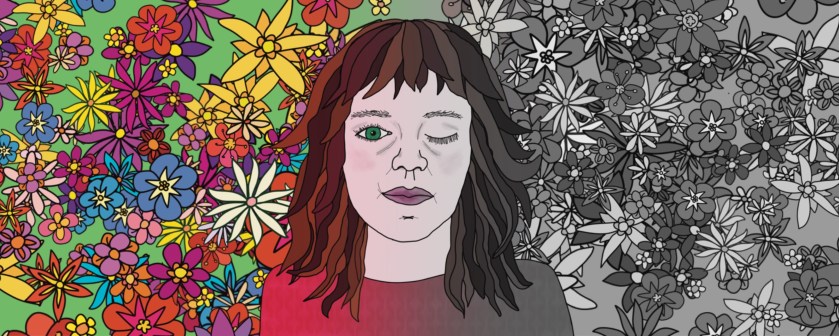
“We all have our seasons/So why should we grieve?” asks Amy Hopwood on Gone To Flowers, a serene examination of aging, dying, and continuing to exist. Her album sometimes can feel a little melancholy, but Hopwood indeed declines to mourn. Instead she turns to a little magical thinking, whether that means imagining how the spirit moves on or how a fairy is gifting her new features of an aging body. There’s humour, fables, and more than anything beautiful images of an afterlife where new friends made and new horizons discovered. And by the end there is an acknowledgement that this whole dying thing is all a mystery, but it’s always approached with curiosity and understanding rather than fear.
“We’re all mortal. We will all die. What it comes down to is how you can have the best life. Can you feel comfortable with the inevitable?” asked Hopwood. “I’m getting older and everyone I know is getting older. You can’t really get away from that. I have elderly parents. I’m always drawn to things that people are trying to avoid. I think a lot of people will try to avoid talking about death, but for me it feels healthier to try to stare it in the face.”
Hopwood uses many devices to get comfortable with the thought, with magic and humour at the forefront. “I’d Rather Be Older Than Dead” captures both beautifully and brings a whole crowd along for the ride. The song is a diary of aging, with each new trait a gift from a fairy. Think stiff joints and more hair in unwanted places. It’s clear Hopwood doesn’t love all these experiences, but she still feels the gifts are genuinely kind: they come along with her ability to experience more years of living. A chorus of pickers from the Weymouth Folk Festival join Hopwood on the refrain. She said it’s proven to be a popular song. She said her examination of aging has even led to gratitude for her ‘deteriorating’ body.
“It will only get worse, that’s the awful thing,” said Hopwood. “When you look at the photos from ten years ago, you think ‘oh, I was beautiful then. I wish I was like that now.’ It’s looking at that attitude and remembering what you have now is good, relatively.”
Fellow festival attendees aren’t the only extra layer of sound on Hopwood’s album. She utilises bird song, rhythmic whispering, rushes of wind and water, and even her elderly cat in creating a very unique soundscape. She’s glad to be able to produce it all herself.
“I enjoy not having to describe it to somebody else who might not understand my work,” said Hopwood of her vision.
If there’s one song on the album that may actually elicit tears, it’s “She Became A Bird.” Yes, the track is completely at ease with the notion of death as describes an elderly woman taking notice of birds as her mind begins to slip. Slowly, they become her escape and she becomes tied up with them in memory.
“My mom has Alzheimers. She’s still with us, but very advanced now. I noticed when I was with her that she had genuinely never been interested in birds and suddenly she was,” said Hopwood. “From there, this magical element comes in where I believe she’s learning how to take flight. That’s fabrication I guess, but it’s a comforting thought.”
Still, the song has a weight to it that others don’t. The observations carry a bit of sadness and the comforting thoughts a little disbelief: “Sometimes it seemed like they called to her/and like she was answering them/but often she seemed very far away/as she talked to her new feathered friends.” It’s evidence that even for someone who is fearless in exploring the ideas associated with death, the loss of a parent is painful. Hopwood doesn’t believe her mother will actually become a bird, but there will somehow be a connection.
“I feel like energy does get absorbed into other things, other creatures. I don’t believe in direct reincarnation. I don’t believe one person becomes one bird. But energy does get absorbed into other things. Different bits of us are in elements of everything. A spirit can become maybe the glint in the eye of a bird,” said Hopwood. “It’s a way of remembering a person, even if you don’t fully believe it. It’s a way of saying their name during a normal day.”
Similarly gorgeous is “The Closest Thing To Holding Hands,” a track in which the living hang onto objects. In picking up something they used to hold, “our hands are moulded to the shape they used to know,” sings Hopwood.
“Just by thinking about the person, you’re bringing them back in a way,” she said.
While some of Hopwood’s ideas are original or specific to her own situation, others are borrowed from the wisdom of our ancestors. They “laid a trail of breadcrumbs through the fairytales they told,” she sings.
“I like folklore and fairytales because we tend to be arrogant. Everything modern is good, everything old is bad,” said Hopwood. “We tend to feel we’re the only people who experienced whatever we’re experiencing. We’re so unique, we’re so special. Billions of people have been around before us. It would be very unlikely that they haven’t experienced a given experience or emotion. I like folklore and fairytales for that. It’s a very soft way of getting an insight into what people think was important. Like psychology light.”
The most direct use of a fairytale comes from “Igor Potemkin Meets Bayun The Cat,” a song that pairs a Russian man of Hopwood’s creation with an actual myth from the culture. Bayun is said to make a person completely healthy, but also devour them the minute they fall asleep.
“There’s the hubris of Igor Potemkin who decides he wants to be well and is not frightened of the cat,” said Hopwood. “But when you aim for perfect health, you’re putting yourself at risk of other things. You can’t really have everything.”
She sees plenty of Igor Potemkins these days.
“There’s a big orange one in America,” she said when asked to name an example. “People having surgery to make themselves look younger. But it doesn’t really work for so long. People have these faces that all look the same.”
Igor did indeed feel “marvellous” that day, but Bayun got his meal.
“All Shall Be Well” has few lyrics, but it’s a standout for the unreal rhythmic chanting. It truly feels ancient. “Never Said” deviates from the main idea of the album briefly to examine childhood trauma and anxiety and does it well.
Through her exploration of death, Hopwood has come to believe in a couple of things. Her idea of the afterlife is best expressed in “In the Whistling of the Wind” and “East of the Sun and West of the Moon.” Spirits drift, communicate with the living in the slightest of ways, and enter an indescribable liminal space. Owl’s hoots and sounds of gusts make it feel a little spookier than some of Hopwood’s more comforting takes on the topic. She indicated that these last two songs come closest to what she believes, though her wishes for after she dies are expressed clearly and beautifully on the first track of the album.
On “A Nice Wooden Bench,” Hopwood shows distaste for crypts, pyramids, and ash-infused fireworks shows when contrasted with the idea of a simple memorial. Even a grave is “a place to sacrifice flowers,” according to the song. She’d prefer a bench be erected in a park near her home as a place for friends and strangers to visit.
“People have a gravestone so people can go there and weep and remember them. But it’s quite a morbid place to be going. I would sit on benches and have no idea who these people are, but they would have an effect on me,” said Hopwood. “I think it’s a very nice thing to do, to leave behind a wooden bench to enjoy life, but remember that it’s finite. Hopefully now that I’ve written it in a song, people will remember that’s what I wanted.”
As for her body: “I’ll return as a million daisies if you scatter me under the trees,” she sings. Instead of being sacrificed, these flowers are growing. It’s all part of her careful balance between exploring an upsetting topic and making something beautiful out of it.
“I’ve always been aware of the fragility of life, that things can change very quickly,” said Hopwood. “I don’t want to be morbid. Knowing that, hopefully you can live a more fulfilled life. Best not to assume.”
Above is the full episode as aired on WUSB’s Country Pocket, including both my interview with Amy Hopwood and the songs we discussed, starting with “A Nice Wooden Bench,” which reflects Hopwood’s actual wishes for her body and memorial. The interview begins with the second video in the playlist. You can hear the show live alternate Wednesdays at 8am on WUSB 90.1 FM or check the blog to watch it as a YouTube playlist. Visit http://www.WUSB.fm and https://amyhopwood.co.uk for more.


