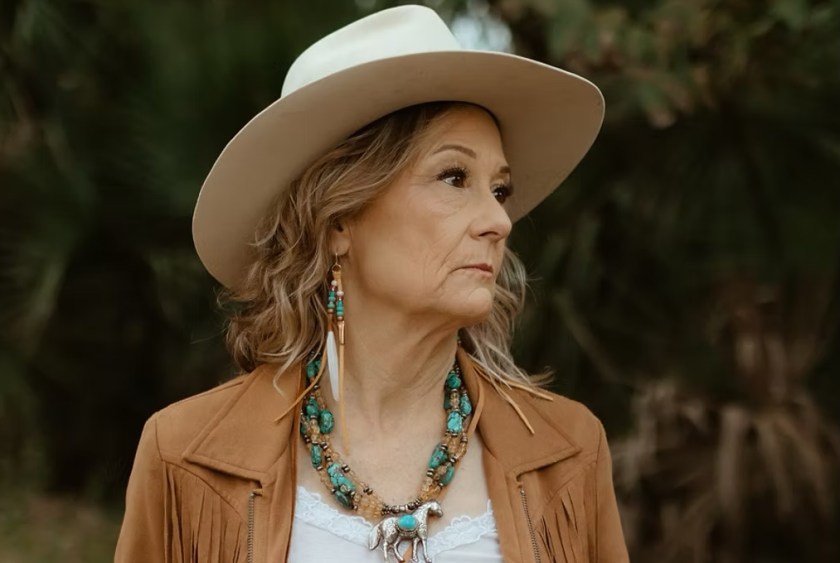
Candace Hastings could have sung some of her new songs angry. “Call Your Mama” and “I Was That Woman” could have easily turned into satisfying tell offs to a man who hasn’t yet grown up. Instead, she wisely charts a different course. There’s a weariness to Hastings’ voice when she starts singing about love. Her lyrics express a desire for something simple and healthy, and a willingness to draw the sorts of boundaries that may lead her there.
“There’s a lot of country songs out there that are binary in nature. ‘He cheated me and I keyed his car’ or ‘he did me wrong but I took him back,’” said Hastings. “I don’t think human relationships are that easy. A lot of us find ourselves in relationships that are complicated.”
The genre of modern country songs that are a bit sour on love or a partner is full is full of anger, betrayal, and exaggeration. Carrie Underwood taking a baseball bat to a sports car makes for a great music video and electric radio single, but not necessarily a roadmap to a healthier situation. Hastings replaces rage with exhaustion, singing as a woman confronting a partner with a boundary. She knows he’s in the process of leaving another woman for her, but insists he properly breaks things off before vanishing. It’s certainly messy, and she seems to understand that she’s not entirely in the clear from a moral perspective. But she doesn’t want another woman to experience the anguish and confusion she once did. It’s a stretch to say the narrator is doing right by the woman being left, but she’s at least doing slightly less wrong. In her quest to make things sound real and complicated, Hastings also finds grace and maturity.
“When you’ve been disappointed, there’s also a matter of maintaining your integrity. What is it that is worth compromising, because we all have to compromise in relationships, but what is worth standing your ground and being a strong woman?” asked Hastings, who often responded to my questions with ones of her own. She seemed to answer with the perspective of her character: “Go ahead and do your leaving. I need you like the stars need the darkness to cut a path across the sky, but not until you do your business.”
There’s something genuinely refreshing about listening to complicated love songs free of anger. For a listening audience in a stable place, they’re relatable. Most people in long term relationships don’t need music that will feed their anger toward their partner. They need something that can help them process emotions and think about the right way to handle situations. They need someone who understands that love is difficult, but also vital.
The album’s first track, “Loving Cowboys,” sets this tone. “Can’t get water from a stone/and I don’t want to be alone,” she sings, seeming to understand the search for companionship is simultaneously frustrating and impossible to abandon. Much like in her songs, Hastings was ready to admit her own flaws in our conversation.
“You have somebody, but they’re never there. What is it that you need in life? How much are you willing to give up when that person isn’t really there for you or they have a love that you can’t compete with?” asked Hastings. “I think it happens to a lot of musicians. When people have dreams that they’re passionate about, sometimes their partners come in second.”
The best songwriting and performance on the album are on “Call Your Mama.” It’s the first and so far only time Hastings has covered another artist. That artist, Mary Beth Schaefer, happens to be her daughter. Hastings sings from the perspective of a woman advising her former partner to call his mother to let it all out. “She’ll absolve you of your sings/she’ll give you the grace you need to go and start again,” the song goes, before adding “don’t you call me to forgive you for my pain.” Again, Hastings succeeds by sounding worn down instead of angry. Like she doesn’t have the energy to deal with this, and perhaps most importantly like she hopes he will get the help he needs.
“Maybe it’s kind, maybe your mama’s the only one who can understand,” said Hastings of her gentle take, one she insisted on rerecording after touring it for six months and coming to understand it better.
The title track is a glimpse into what Hastings feels she needs at this point in her life. “If you can love someone you don’t understand,” she sings as a must have for any resumé.
“You don’t always have to understand somebody to love them, said Hastings. “You can love them in all their complexity. That’s what a true partner is. They don’t want to remould you”
Hastings’ take on communicating boundaries sounded realistic and measured. She indicated that the ability to take such stands comes from life experience, but isn’t a guarantee of success.
“If they don’t, that’s not on you, that’s on them,” she said. “Then you get to decide what you do after that. You can only communicate.”
That made me all the more shocked to learn that she doesn’t consider herself particularly communicative. She referenced “Come Home” as being most like her communication style, concerning because the narrator’s cluelessness evokes both heartache and a bit of pity. She’s writing a letter to her man in order to ask him back, because he “told me not to phone,” she sings. This is all being done at the earliest as Autumn turns to Winter, though she’s only now updating him on events from the Spring. And while she’s hoping against hope, she’s saying it’s not clear to her why he left. I suspect Hastings is underestimating her ability to get a message across, as evidenced by the fact she’s put out songs doing just that.
“Maybe it’s a hope. Maybe writing these more direct songs is more hopeful of what I’d like to be instead of who I am,” said Hastings. “I was raised in a family where you didn’t really communicate your feelings. I have an adopted family and a birth family. In my adopted family, it was Scandinavian. You don’t really share your feelings. It’s easy to fall into those communication patterns that you’re very used to with your own family. And breaking out of that is I think somewhat terrifying, but also healthy.”
That leads neatly into the portion of the album that takes place on the tribal lands of the Citizen Potawatomi Nation. It’s a beautiful and unexpected happy ending that really does seem to provide Hastings with a “Soft Place To Land,” so to speak. It’s provided her with a new identity, outlook, and, most importantly, sisterhood.
“I knew nothing about my birth family growing up. Separation in indigenous families is fairly common,” said Hastings. “My birth mother had nine children; I was number four. I had no idea about my indigenous heritage, or any of my heritage actually. I found my birth family not that long ago, maybe five or six years ago. It made a lot of sense to me. Spiritually, I always thought differently. I started learning a lot, going to Shawnee a lot, taking intensive language classes, got my native name. It’s been a full circle resolution that has changed my life and has made me understand how I belong, where I belong, and what it means to be a part of the community and reclaim my identity when there’s so many challenges with being indigenous.”
On “As Eagles Fly,” a reference to a tribal belief about eagles carrying prayers, she releases that flood of emotions. There’s a sense of love and belonging that had previously been missing: “They never let me dwell on the things that might have been/Put their arms around me said ‘you’ll never be alone again.’” There’s also an abrupt shift to recognising injustice from the United States government and the fact that the whole world seems to be on shakier ground lately. “Anger born of sadness makes a tender heart go blind,” she sings, quickly pivoting back to the mature voice from earlier in the album. Along with the love, the difficulties, and a new name that translates to Red Sky Woman, Hastings has found further perspective.
“We think seven generations prior and seven generations ahead. Seven generations ago, my fourth great grandparents were removed from where they were staying in Indiana and force marched to Kansas,” said Hastings. “When we make decisions, we think seven generations ahead. What’s important is that we’re still here.”
Above is the full episode as aired on WUSB’s Country Pocket, including both my interview with XXXXXXXX and the songs we discussed, starting with Loving Cowboys, which outlines the difficulty of searching for adequate companionship. The interview begins with the second video in the playlist. You can hear the show live alternate Wednesdays at 8am on WUSB 90.1 FM or check the blog to watch it as a YouTube playlist. Visit http://www.WUSB.fm and https://www.candacehastings.com for more.


