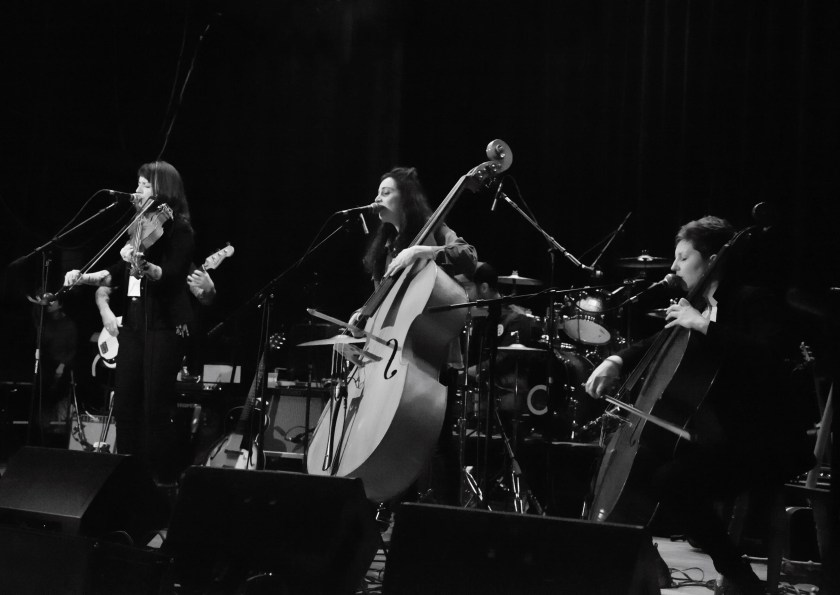
MorganEve Swain is no stranger to profound pain. Her husband and Brown Bird bandmate Dave Lamb died in 2014, and her first album under The Huntress and Holder of Hands very much felt like an open wound. It took ten years for her band to release a followup, and Swain’s lyrics are still just a way to process grief. This time, she’s focused on injustice and how far people seem to keep falling.
“The grief is a more universal feeling. It’s more about a global grief for the state of the world,” said Swain. “America is burning. The whole world is burning. How do I even break it down? I feel like there are so many things that are troubling. The presence of racism that is rampant, general inequality all over the place, the state of the planet itself. All of that stuff is so heavy and forward on people’s minds, as it should be.”
The lyrics of Babylon have aged tragically well. Songs Swain wrote in 2016 around the time of her last album were still able to make the cut, perhaps even more relevant now than then. Her folk music contains just a hint of grunge with its dark lyrics, minor harmonies and heavy edge. “We shroud our children/hide them away/your doctrine damns us all/you teach them violence/as you kneel to pray/your doctrine damns us all,” Swain sings in “Doctrine.”
“The album is called Babylon. Biblically, Babylon is a warning,” said Swain. “Don’t get ahead of yourself and don’t be worshiping false idols. That’s the state of our world in a lot of places.”
The 2016 Donald Trump she wrote that about was disowned by a significant portion of his party for bragging about sexual assault. In 2026, it’s difficult to find Republicans willing to touch sex trafficking investigations for fear of what they might uncover about the boss. The children she was worried might receive a miseducation grew up exposed to Andrew Tate and laws limiting the discussion of race in schools, even as high as the university level. The notion of equipping the next generation recurs on Babylon.
“It’s a warning to pay attention. If we’re teaching our kids one thing, we have to make sure we’re teaching them everything. To think for themselves and how to be a good citizen for the world,” said Swain, who felt her own education in Connecticut was lacking. “I didn’t see racism at all. There was no diversity to speak of. In the rest of the country there was a huge discrepancy, and I just didn’t know. It’s an injustice not to teach kids about the world just because it’s not in their immediate world. I feel like that history was hidden, and maybe that was hopeful thinking, but then at the same time, it made me unprepared to deal with the fact that we are absolutely still living in that reality that I thought was over.”
Songs about personal loss such as “Absence” still ring true for Swain, who showed visible signs of grief even 12 years after Lamb’s passing.
“I was 23 when I met Dave. Musically I really feel like I grew up with him. Found my voice and my confidence. Very gently, without being a teacher to me, he just nurtured this person I knew I could be but hadn’t become yet,” said Swain. “He was funny, he was incredibly smart, he was very thoughtful. He loved thinking about the thread that tied all of humanity together. He was raised very Christian and he rejected that in a very loving way. He was just a very loving, empathetic human.”
On an album that describes systemic injustices, it’s interesting to see Swain take the same approach in describing her own loss: “You belong here with me/I can’t make sense of your absence/don’t matter how many years go by/you’re still meant to be here with me.”
“That song was written in a night where I was very struck with waves of grief that were all encompassing,” said Swain, who wrote the song and recorded a demo in one night. “In a state like that where I’m so emotional, there is that sense of injustice. He should be here. Why did it have to be him? Everybody has that sense when they lose someone they love. Logically, intellectually, that is not how I feel. With his death, I learned more about myself and my independence. I think I would have kept learning things from him if he had lived, but finding that lesson is just so important to me and helps in the grief process.”
Even in the despair of Babylon, there are hints that Swain is prepared to take on the crisis she faces now. “The waters rise and so shall I,” she sings in “Promethean,” focusing on changing her reaction rather than escaping the metaphorical (or perhaps literal, given the state of the climate) flood. “Feel the tremors start to fade/I’m alone but not afraid,” she adds in “Ritual,” beginning to recover from loss. And the album contains a new take on “Bilgewater,” a fairly hopeful song originally penned by Lamb and performed by Brown Bird.
“Beasts” is the harshest song on the record, one that recoils at the collective actions of humanity: “We treat the Earth as a thing to own/a beast to break/what gave us the notion/that life was ours to take?” Swain prefers not to tell listeners how to interpret the songs, but she described this one as particularly hard not to understand. Her assessment of our record is not a positive one.
“I certainly hope that it’s not too late. We are beasts, but I hope we can redeem ourselves,” said Swain. “I think that it’s possible to live a good life and love and be content in your own little world and also not be ignorant. I do think that our friendships and our communities and our families are how we make things better. It is possible for me to go outside and play in my garden and love my partner and be a happy person and also know that there are systems in place that are damning us. You can have a balance of being personally happy and safe and fighting for everybody else in the world.”
Swain does not believe in achieving bliss through ignorance, but by fighting on knowing full well what she is up against.
“If you’re complacent and let the conveniences take over instead of thinking about what you’re doing and what you’re consuming, you’re part of the problem,” said Swain, who presented the solution as local action and critical thinking. “We keep being active in our communities and we keep making art. That’s what we’ve always done and that’s what we’ll do now, damn it.”
Swain is certainly not about to give up hope, but Babylon refuses to end on an upbeat note. “Thunderstorm,” the last track is a simple plea for mercy followed by a bleak and majestic instrumental befitting of a massive approaching storm cloud. The news cycle does not seem to be slowing down, and Swain isn’t looking to the clouds for silver linings. If her request for mercy goes unheard, she’s already outlined ways of preparing through careful consumption and teaching the next generation how to do better. To the extent that Babylon does offer an escape from the darkness, it’s in a list of ways to rise with the waters. That may only be possible if we acknowledge that they’ve been rising and that the clouds on the horizon are likely to raise them higher.
Above is the full episode as aired on WUSB’s Country Pocket, including both my interview with MorganEve Swain and the songs we discussed, starting with Doctrine, which is unfortunately aging like the sort of wine consumed at an elite golf club. The interview begins with the second video in the playlist. You can hear the show live alternate Wednesdays at 8am on WUSB 90.1 FM or check the blog to watch it as a YouTube playlist. Visit http://www.WUSB.fm and https://thehuntressandholderofhands.net for more. Photo credit Liz Todd.


